McLaren Dealership

Portfolio
Agenda
- Problem statement
- Stakeholder interview
- Competitor analysis
- Target audience
- Survey
- User interview
- UX-personas
- Sitemap / UserFlow
- Brainstorming
- Wireframes + kit
- Usability testing
- Mooboard
- UI +kit + Prototype
- Results

Problem statement
During the analysis of the premium automotive market and target audience expectations, a key problem was identified: potential McLaren customers lack a dedicated digital product that provides a full premium brand experience before contacting a dealer.
Existing digital solutions mainly focus on model presentation, lack emotional engagement, provide limited transparency in configurations and pricing, and do not combine brand history, product, and services in one cohesive environment.
Therefore, there is a need for a separate website that emphasizes the brand’s status, provides clear information about models and configurations, and creates an emotional premium experience through design, content, and interface.
Stakeholder interview
As part of the work on creating a new McLaren dealership website, an in-depth stakeholder interview was conducted. The aim of the interview was to clarify business expectations, strategic goals and key requirements for the future site from the perspective of the McLaren brand and the dealership.
Information must be structured and transparent
Users should quickly understand: specifications, configurations, photos, and the differences between model versions.
Premium feel is the key factor
All interface and content elements should create the feeling of the McLaren brand.
Simplicity of the main scenario
Main action: view the model → get a consultation.The entire UX is built around this.
Visuals and emotions are the most important
Strong focus on media.

Competitor analysis
Lamborghini
Lexus
Competitor analysis focuses on the UX solutions of premium brands to understand what elements create a sense of “luxury” and efficiency. This will allow McLaren’s future website to become recognizable and functionally superior to its competitors.
Porsche
Must have
Hero video or 3D animation of the car on the homepage
Car configurator (Build your car / Configure your model)
High-quality gallery (4K) + video review of the model
Clear CTA buttons: Book test drive / Find dealer / Contact manager
Information about service, warranty, and accessories
Nice to have
Online service booking
Multilingual support
Financing / leasing calculator
CRM integration for personalization
Chat with a manager
Attractive
Background video with the characteristic engine sound
Motion design and scroll efects
Pages with customer stories or brand events
High emotionality of content (sounds, speed, details)
McLaren Experience / Club / Behind the scenes - fan engagement

Target audience
Knowing your target audience (TA) is a place to improve design, functionality, and communication with user needs, ensuring higher levels of engagement and satisfaction. This allows you to focus development and marketing, creating a product that is more effective and valuable to its users.

Primary Audience - Affluent customers
- Appreciate prestige, power and unique design.
- Look for personal service and privacy.
- Often choose a car as a status symbol.

Secondary Audience - Brand fans
- Watch news, events, McLaren Experience.
- Interested in the history of models.
- Very sensitive to interface design.
- Frequently share materials via social networks.
Tertiary Audience - Young enthusiasts
- Fans of McLaren technology, speed and design.
- Active on social media, shaping the brand image online.
- Dreaming of owning or test driving in the future.

Survey
To create a website that accurately reflects the expectations of McLaren customers, an online survey was conducted among potential buyers, luxury car owners and automotive enthusiasts to identify key needs, expectations and priorities for users when interacting with the brand.
Demographics
Key Findings
Respondents: 1250
Gender: 68% Male, 30% Female, 2% Prefer not to say
Age Range: 25–60
McLaren is a brand associated with exclusivity, power and emotion. The survey results helped to define the main design guidelines for the dealership's future website:
84%
Users can expect convenient access to complete information about models and prices.
68%
They want to see a realistic online car configurator.
55%
They consider it important to have a convenient way to communicate with the manager.
70%
They value exclusive content about new models, brand history, and McLaren events.

User Interview
As part of the research, we conducted 10 in-depth interviews with potential McLaren customers to better understand their needs, expectations, and barriers when choosing a sports car. The insights we gained helped identify key areas for site development and improve user experience.

Question
What makes the process of choosing a car online the most difficult?
Answer
There is a lot of information about the models, but I want to see everything in one place.
There is a lot of information, but it is unstructured.
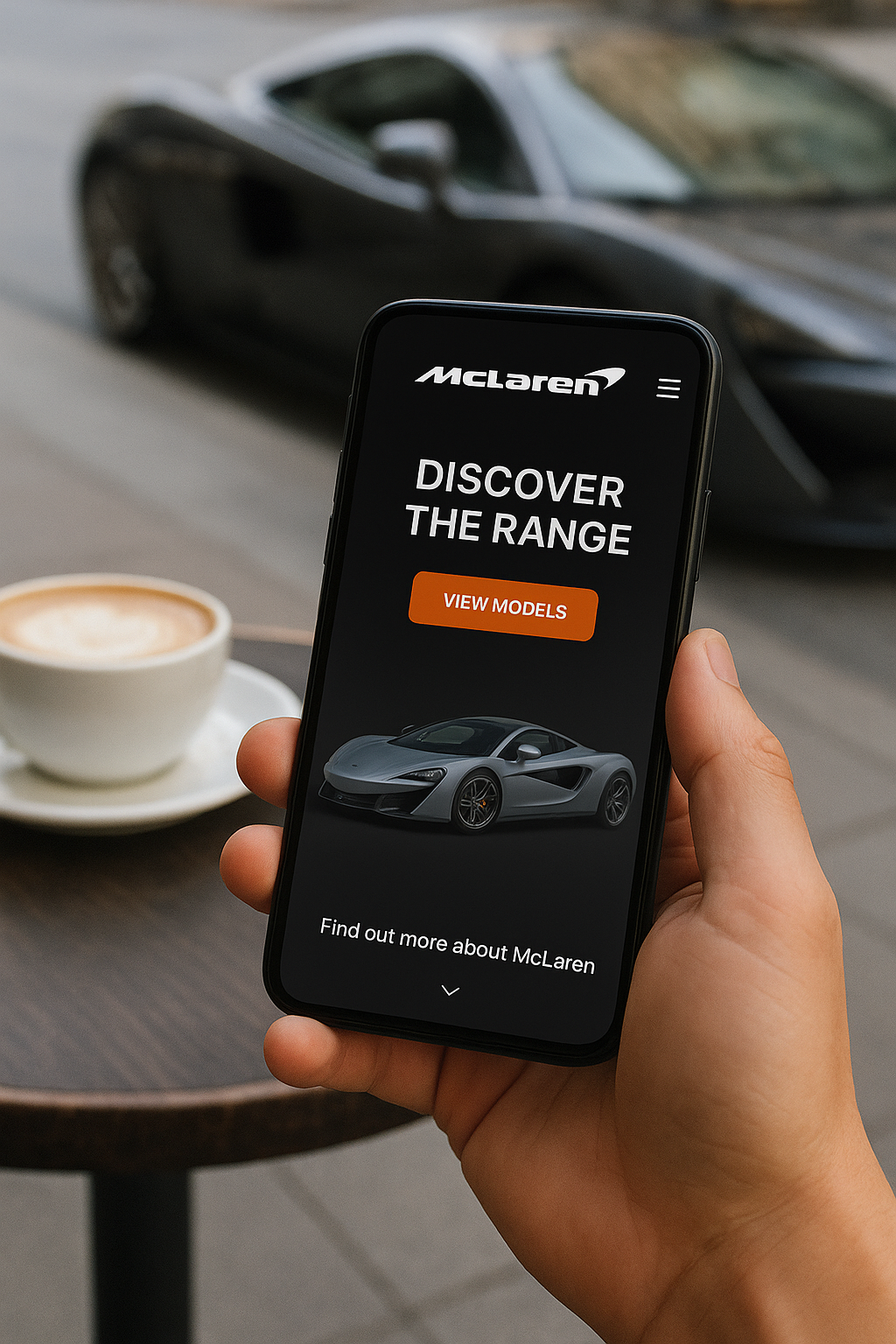
Emotional content - potential customers expect a premium experience right on the website: videos, engine sounds, owner stories.
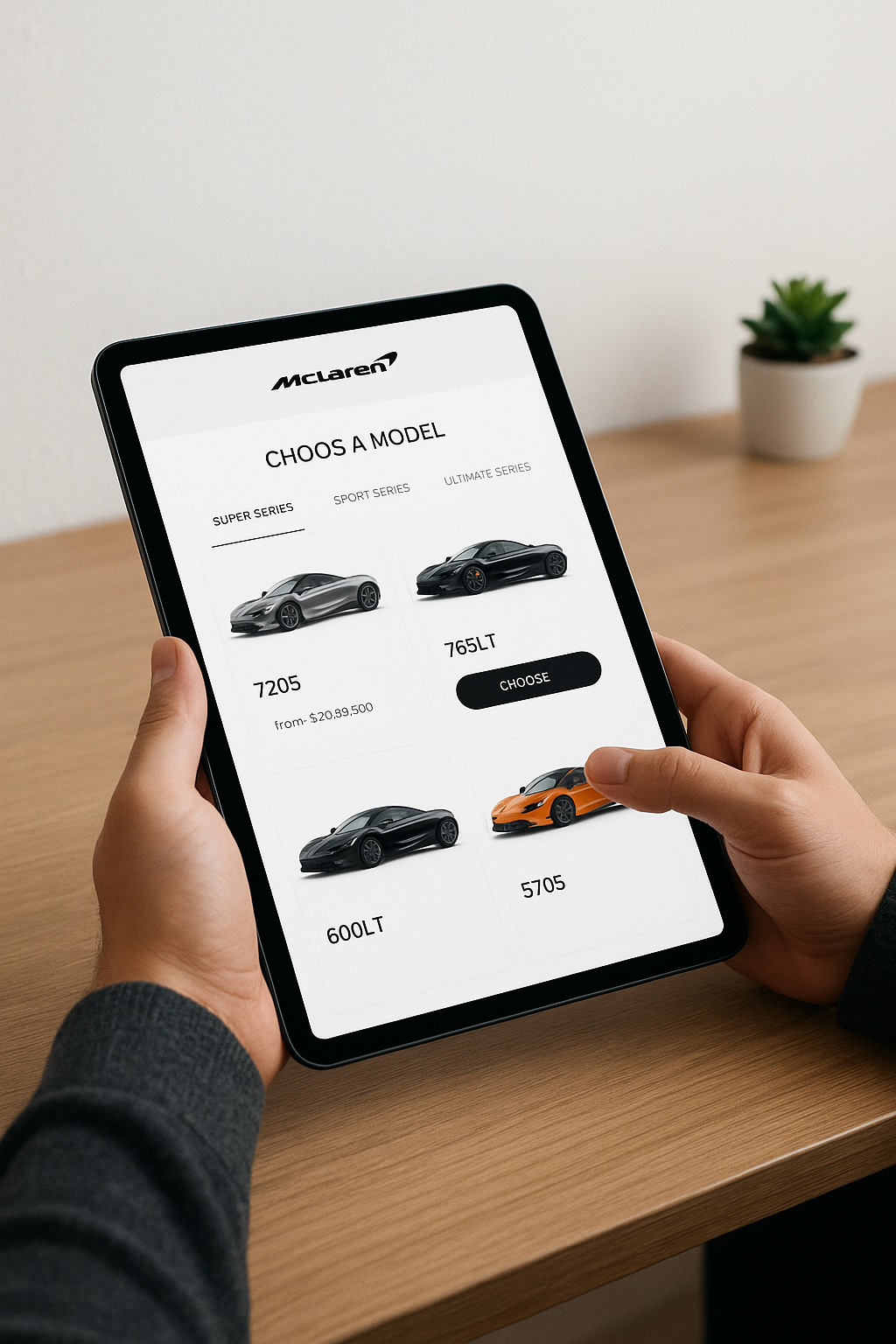
Transparency of prices and trim levels - users want to quickly see the cost and difference between car versions.

Mobile usability - users often browse the site from a smartphone, so they expect perfect adaptation.

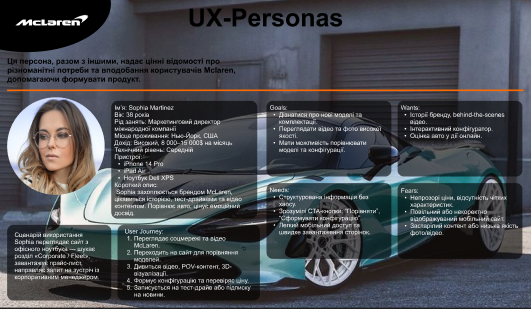
UX-Personas
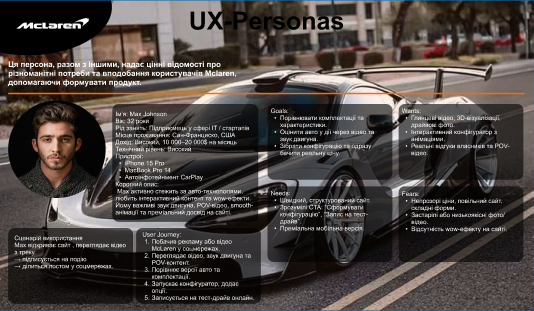
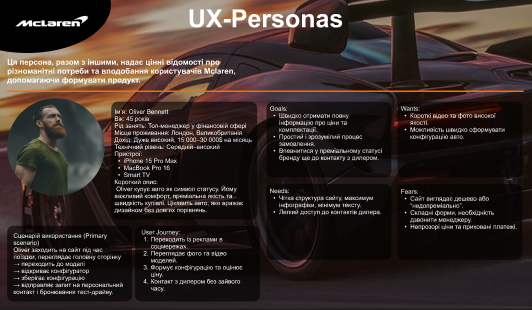
Based on the research, user interviews and target audience analysis, three key UX personas were formed, representing the main groups of users of the McLaren dealership website. Each persona reflects: user motivation, their goals, needs and expectations, potential barriers in interacting with the digital product.
Sitemap / UserFlow
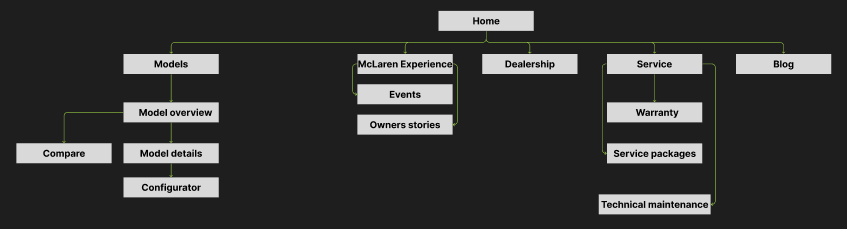
The Sitemap and User Flow were developed based on UX research, interviews, and UX personas to create a logical, understandable structure for the site. The Sitemap defines the logical structure of the site, and the User Flow is the key user path from brand discovery to dealer interaction, formed based on UX research and personas.


Brainstorming
To develop the concept for the McLaren dealership website, a brainstorming session was conducted with a team of five participants using the Walt Disney method. This approach involves dividing into three roles: Dreamer, Realist and Critic. This methodology allowed us to consider ideas from different angles, from the most daring concepts to their real implementation and potential risks.
Dreamer
Participants: Maksym, Anton
Main ideas of Dreamer:
- Full-screen 3D car configuration: the ability to rotate the car in real time, change the color, carbon packages, interior, wheels and immediately see the cost.
- Interactive acceleration 0-100 - animation, where the car "bursts forward" on the page scroll.
- Cinematic video hero block with engine noise and dynamic transitions.
- Personal offers "McLaren Experience": test drive on the track, individual car presentation, VR-tour of the salon.
- Emotional section "Owners Club" with owner stories, exclusive events, club trips.
Realist
Participants: Oleksiy, Viktor
Key Realist decisions:
- In the first release, focus on UX-simplicity, speed and structure of the model catalog.
- Videos and animations - only optimized so as not to burden performance on mobile.
- 3D configurator - possible, but simplified: colors + wheels + interior (without complex packages).
- The “Trade-in / Financing” section should be as accessible and understandable as possible - direct CTAs, simple forms.
- If necessary, the design should be adapted to the global McLaren brand guidelines.
Critic
Participants: Igor, Kateryna
Critic's main comments:
- Excessive animations can slow down the site and worsen SEO.
- 3D models are resource-intensive: may not work on weak smartphones.
- Avoid “premium overload”: UX should remain simple.
- McLaren cars have a small audience, so the section with unique offers should clearly segment users:
- supercar fans
- real buyers
- young enthusiasts
- Competition with other premium brands (Porsche, Ferrari, Lamborghini) requires uniqueness, not just repeating the style.
Wireframes + Kit
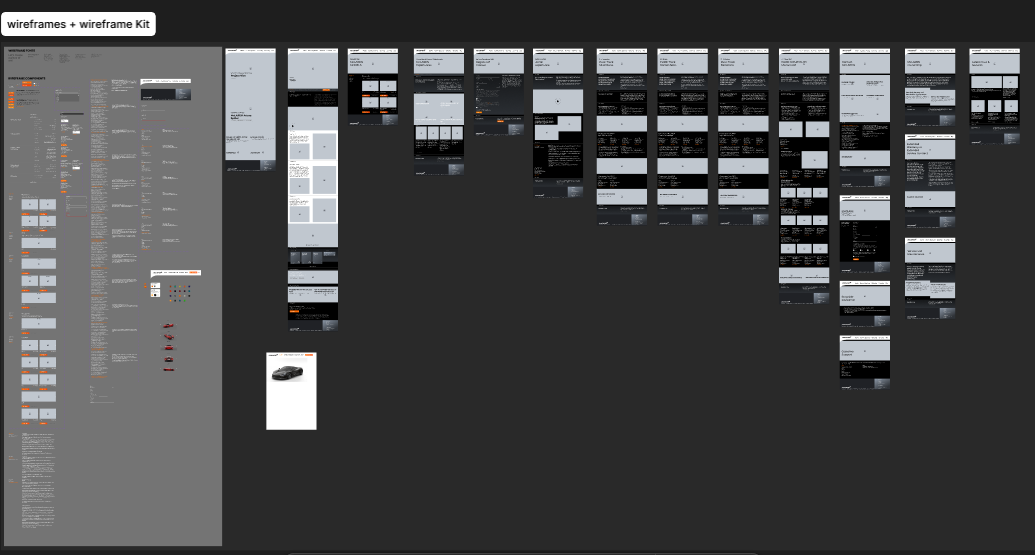
Wireframes were created to work out the structure of the pages of the future site and determine the logic of placing key interface elements. At this stage, the main attention was paid to the information hierarchy, navigation and user interaction scenarios with the site in accordance with the results of UX research. Wireframe Kit was developed to unify the basic interface elements on all pages of the site.

Usability testing
The purpose of usability testing was to assess the effectiveness and usability of the hi-fi prototype of the McLaren dealership website, as well as to confirm that the developed information architecture, navigation, and main scenarios meet the needs of users identified during the research stages (Competitor Analysis, Personas, User Interviews).
Members
10 UsersProfiles: premium buyers, brand fans, young enthusiasts.
Method: Remote usability testing (Zoom + Figma prototype)
Task
- Find model McLaren and open its detailed page.
- Configure your car.
- Check price.
Metrics
- Completion Rate: 92%
- Average Task Time: 1:47 хв
- User Errors: 6 Totally
- CSAT (Customer Satisfaction Score): 4.6/5
Key insights
- Users liked the clear page structure
- The configurator is easy to understand, but users want more options on the side
- CTA buttons are noticeable and logical
- Main issues: searching for the “McLaren Experience” section, insufficient visibility of the FAQ

Moodboard
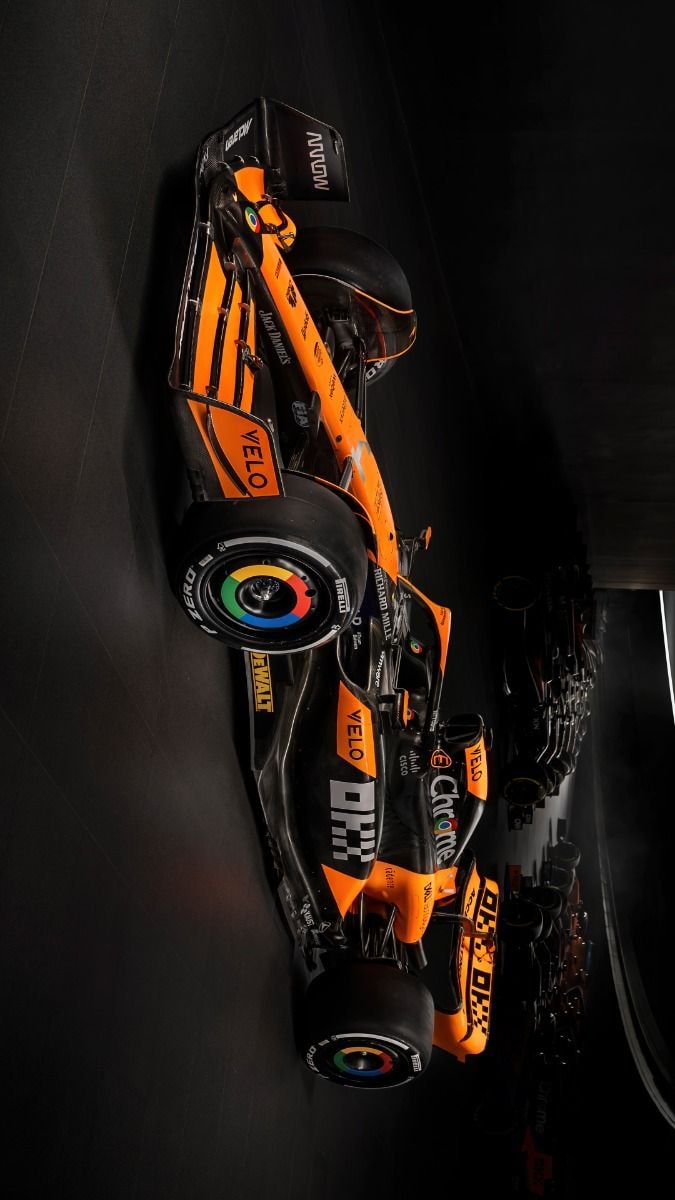
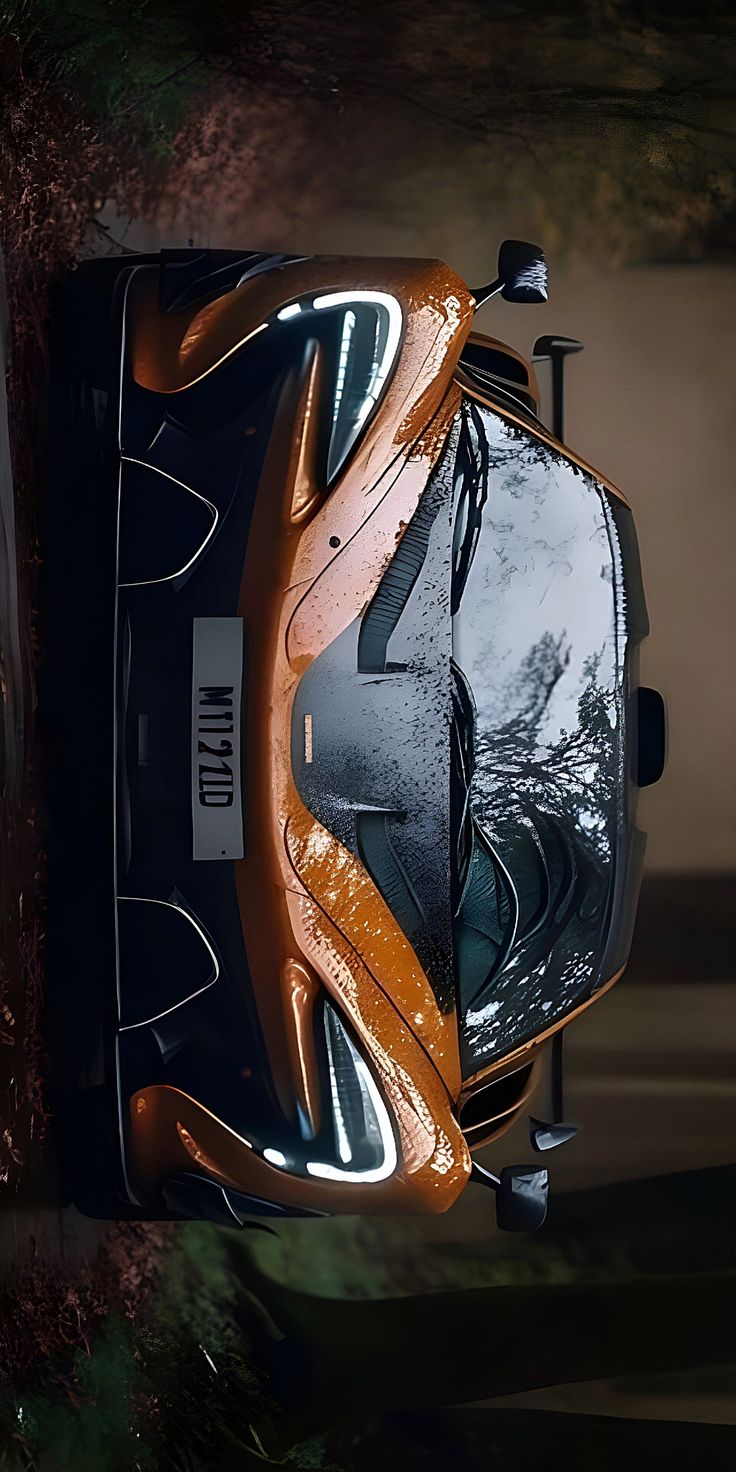
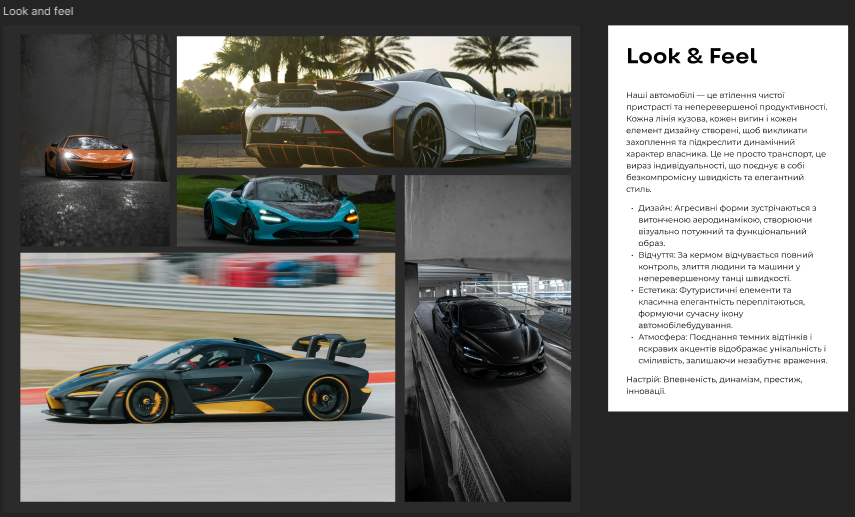
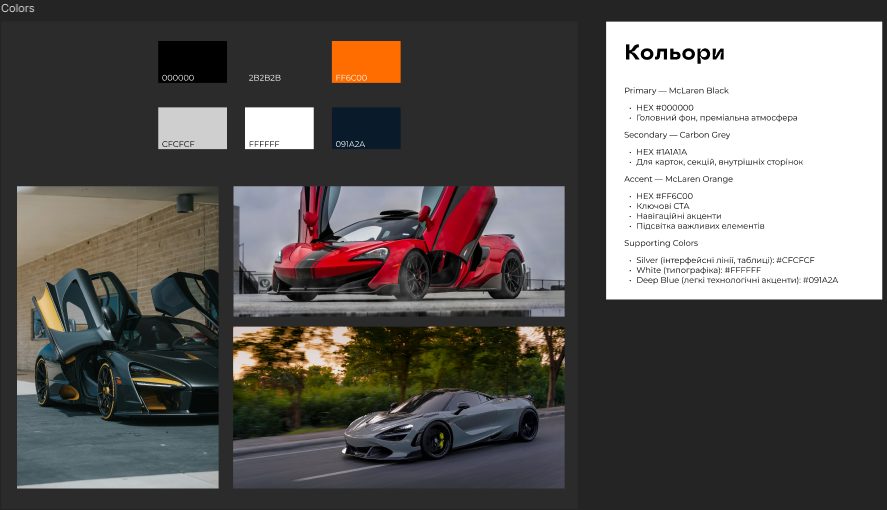
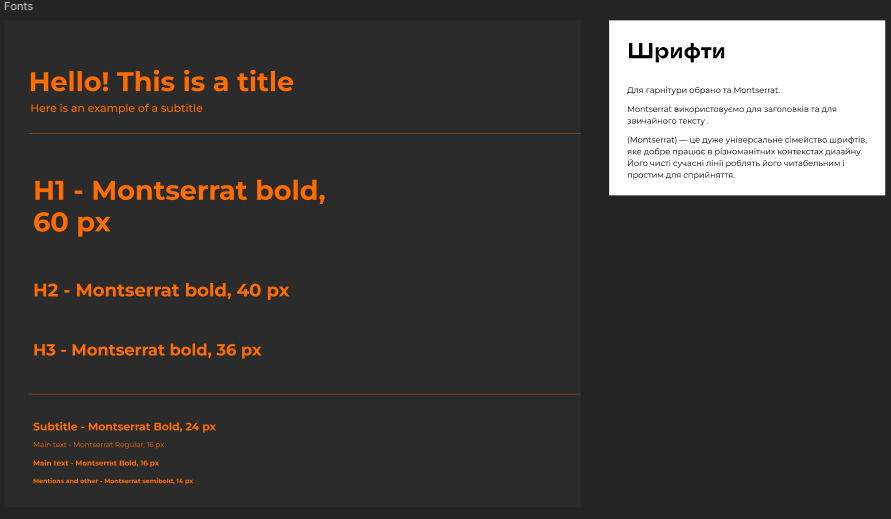
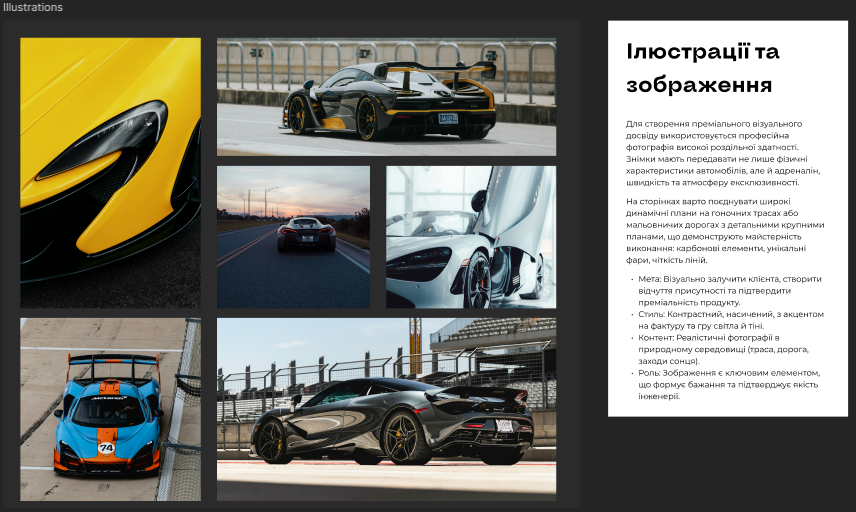
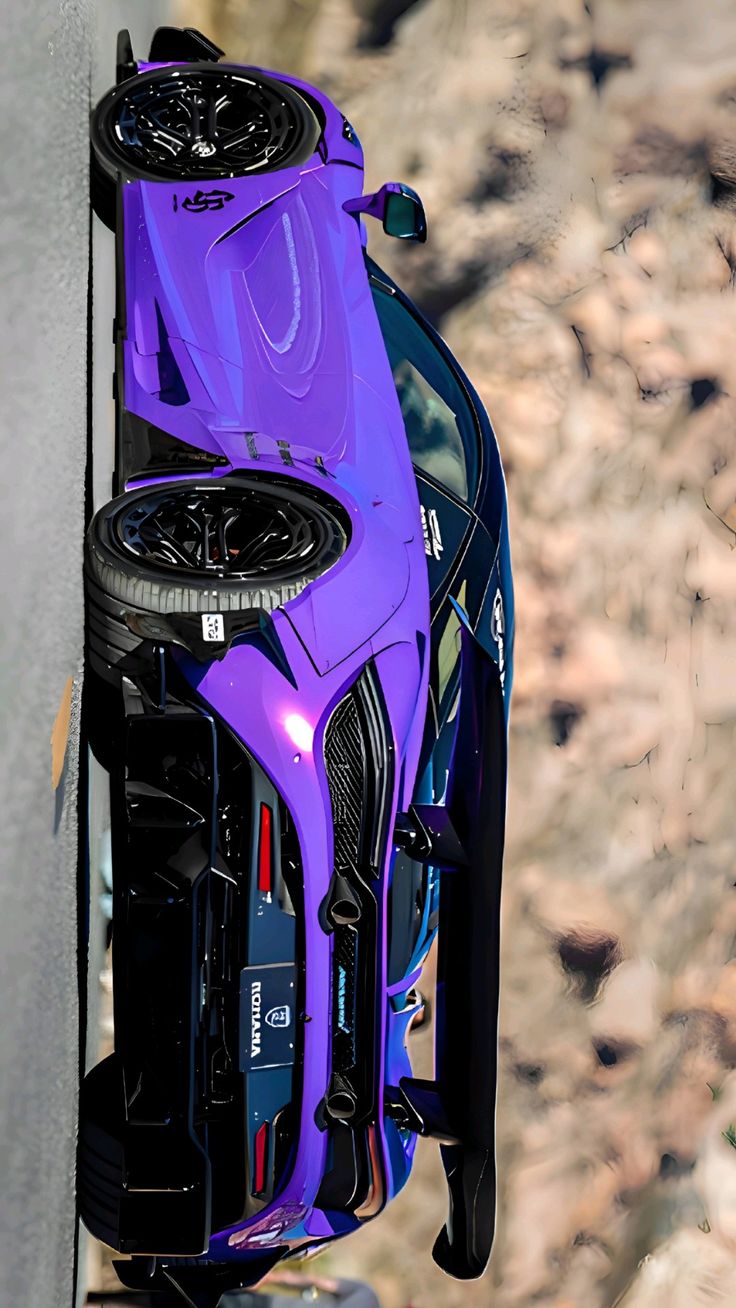
The moodboard was created to define the overall visual direction of the future site. It reflects the key brand associations: premiumness, speed, technology, and emotion. The moodboard became the visual basis for further UI design and ensured the integrity of the style across all pages of the site.
UI / UI Kit / Prototype
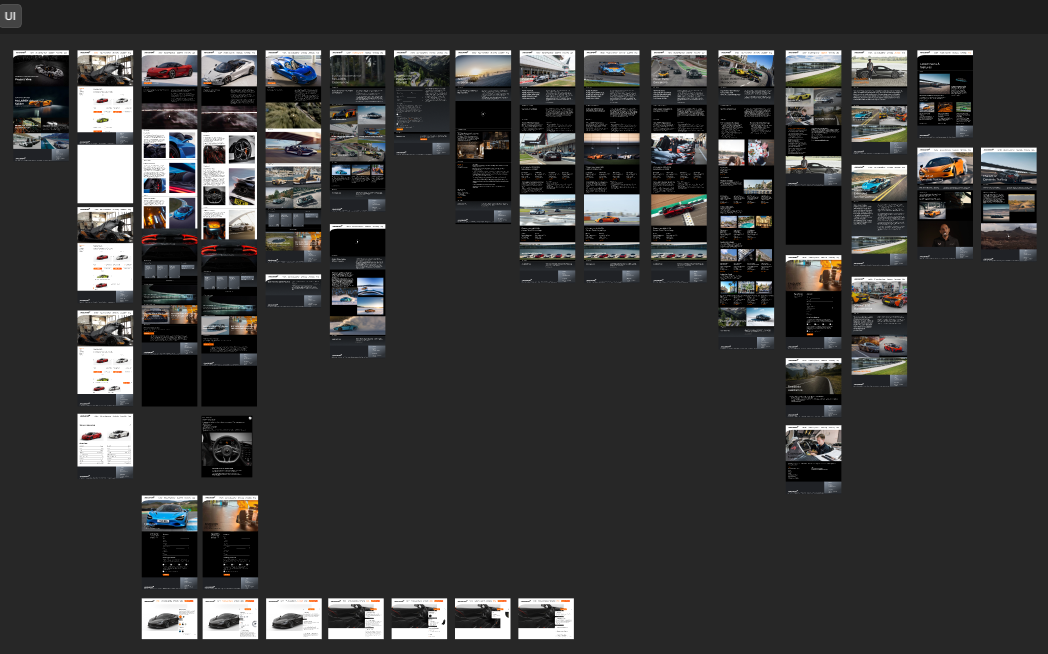
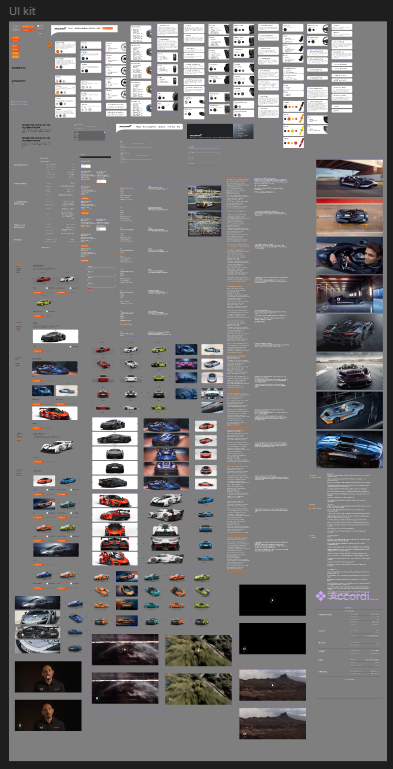
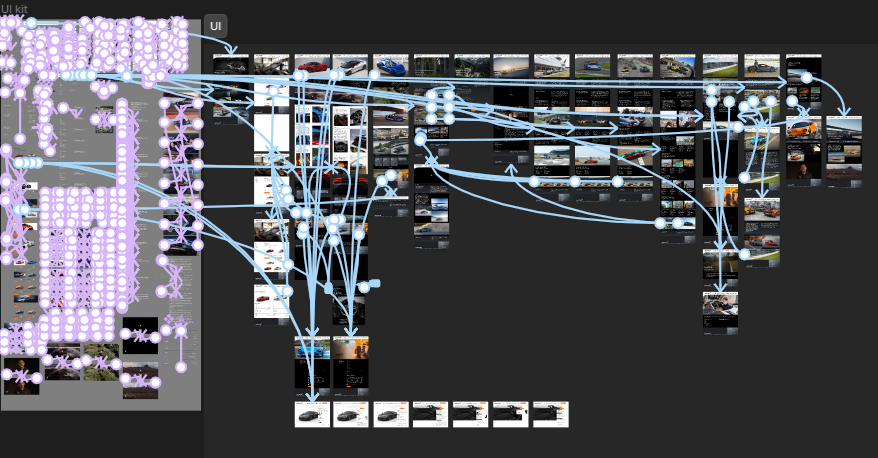
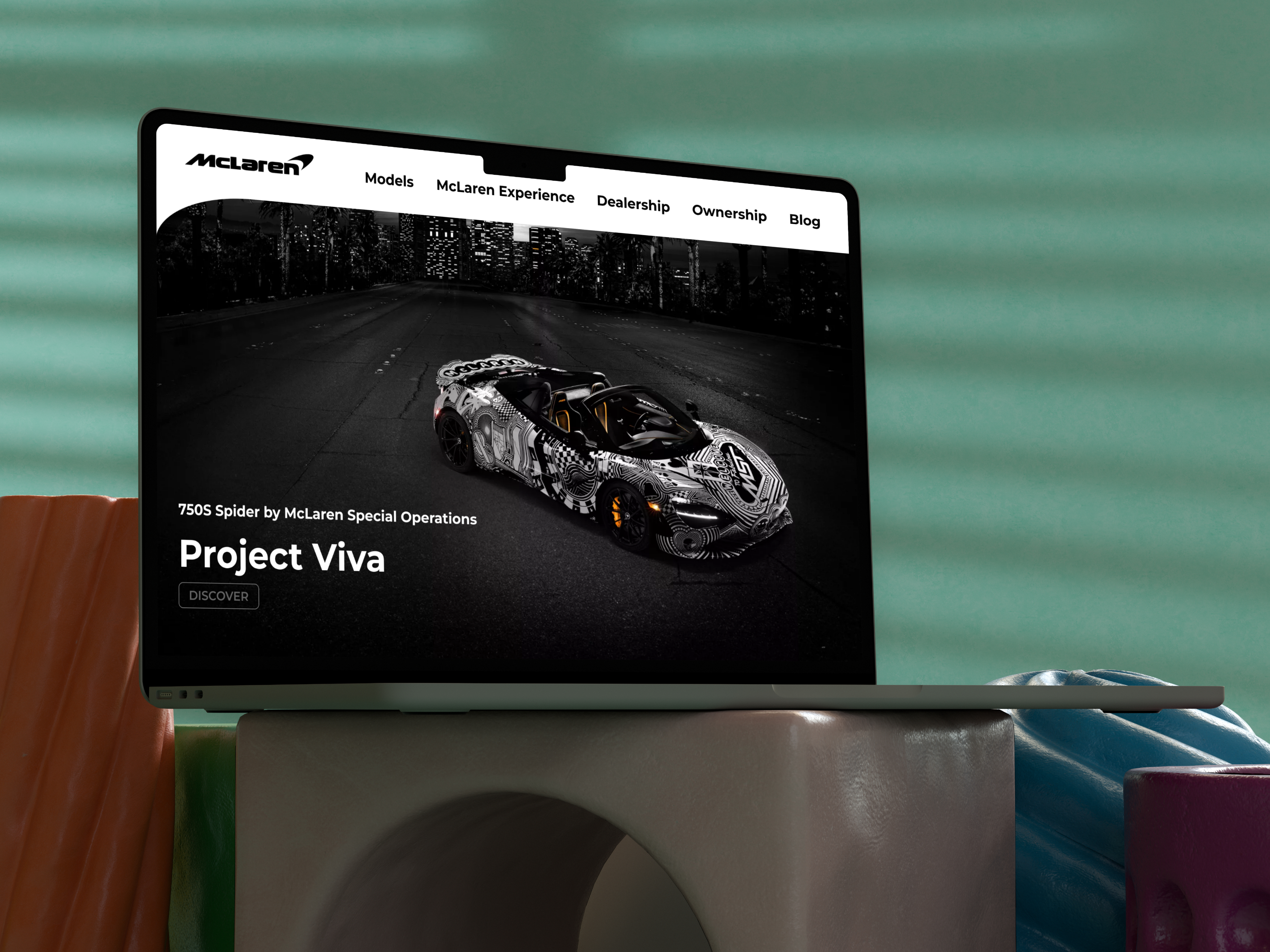
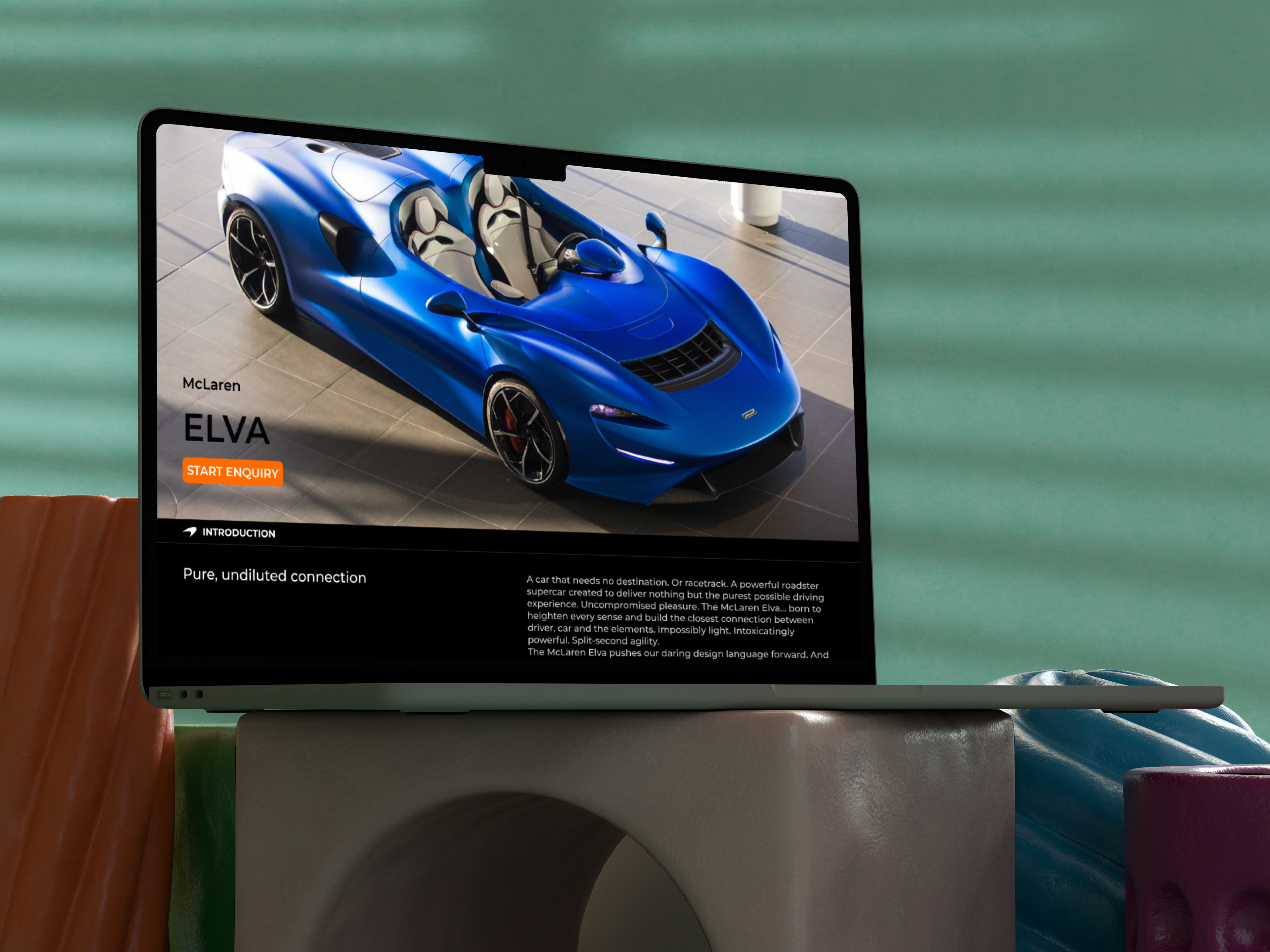
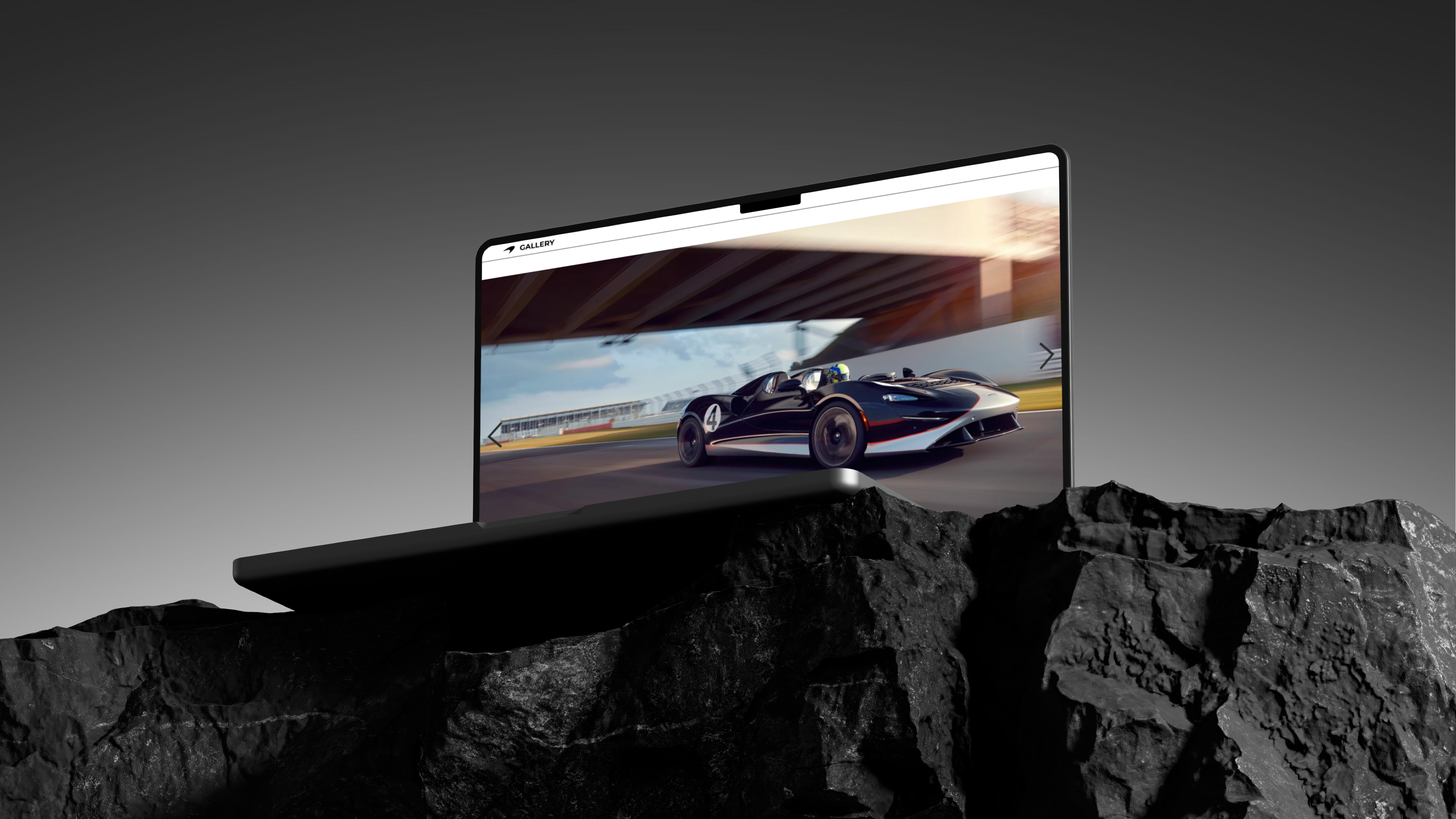
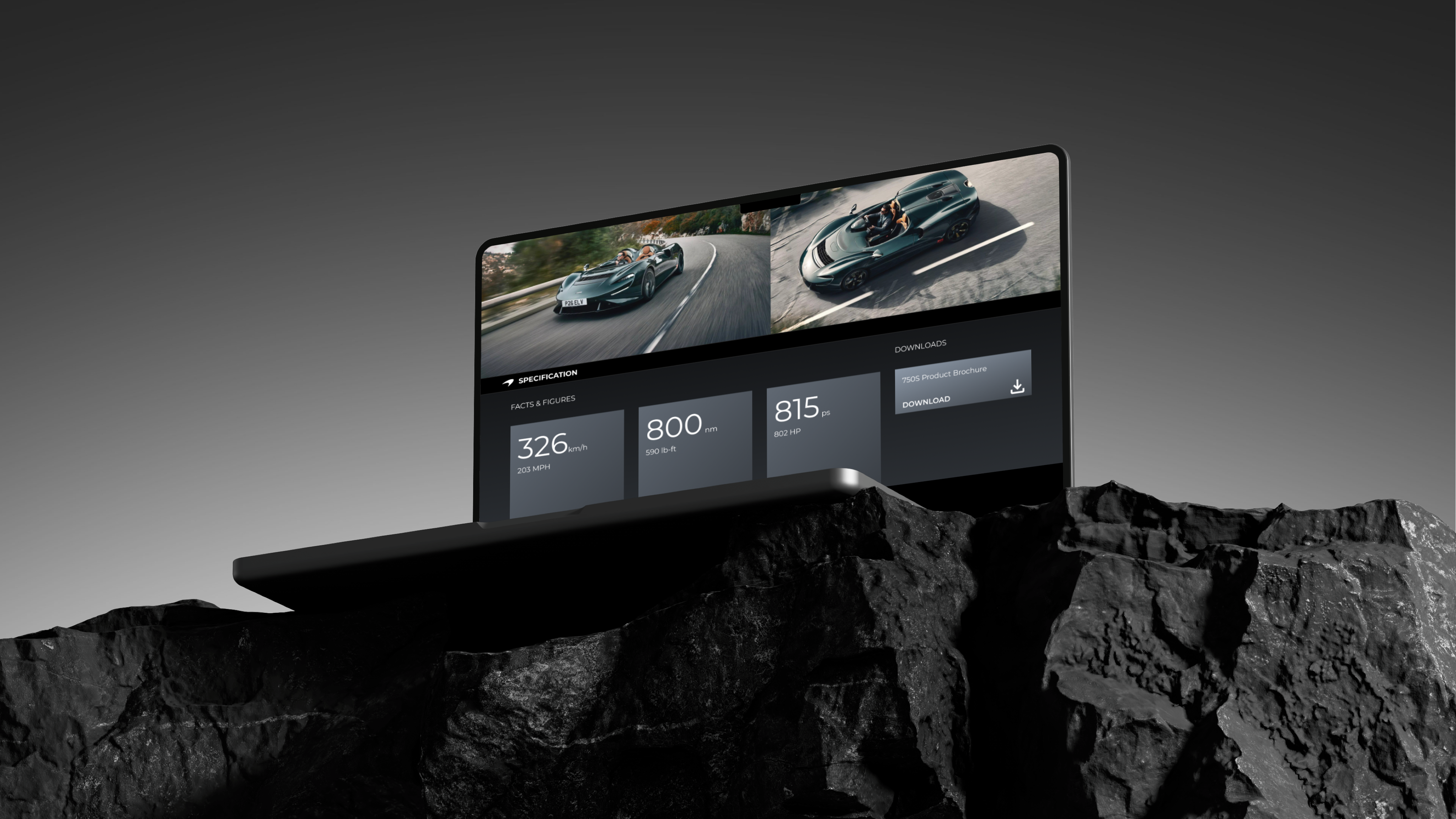
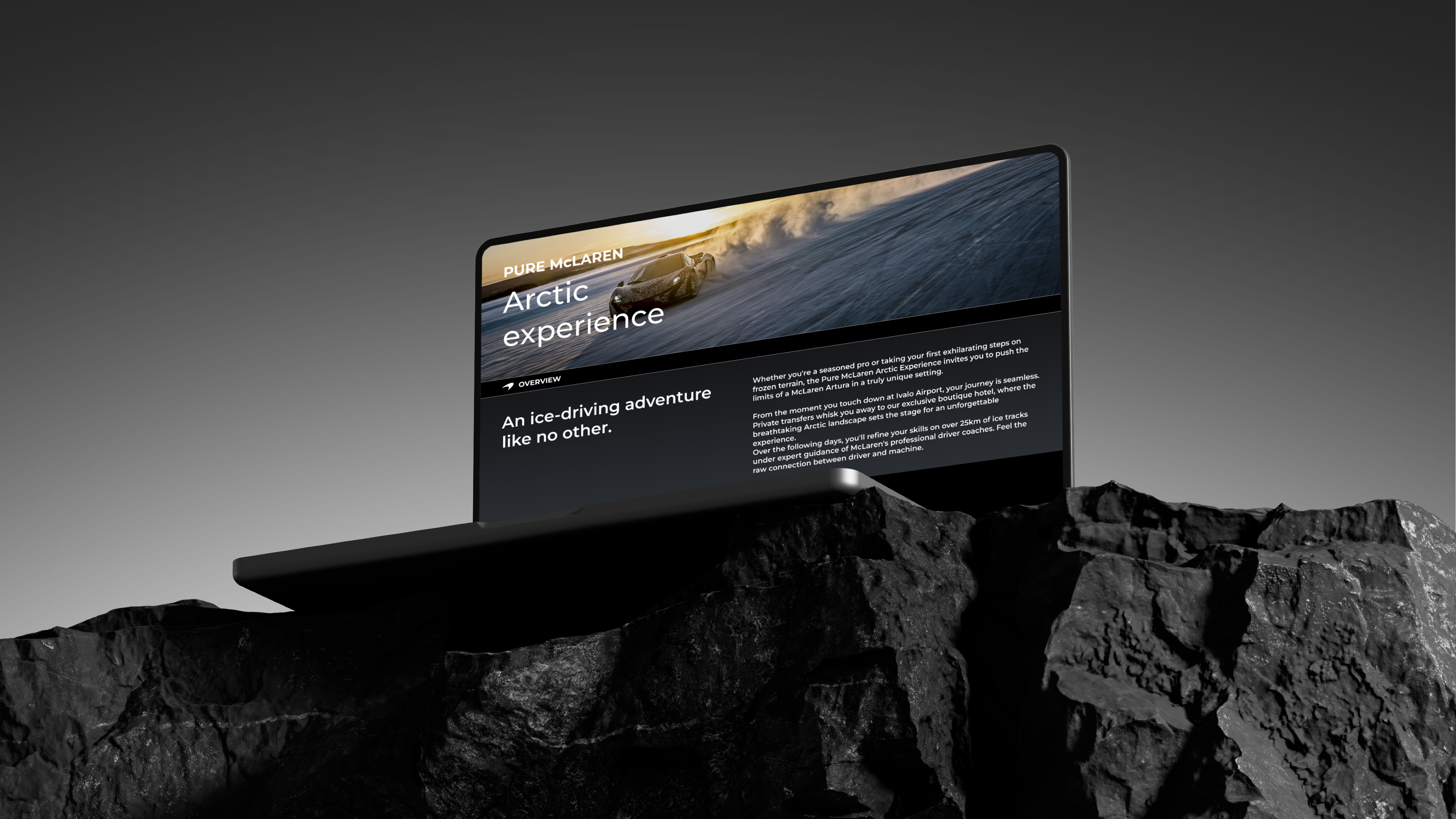
The UI defines the visual style of the site, the UI Kit ensures the unity of all interface elements, and the interactive prototype demonstrates key scenarios of user interaction with the product.

Results
As a result of UX research, competitive analysis, user interviews, persona building, sitemap creation, user flow, and prototypes, an interface for the McLaren dealership website was developed. The project became the basis for implementing clear navigation, transparent pricing, and an emotionally rich user experience that meets the expectations of McLaren’s premium audience.
89% Task Completion Rate
Users successfully completed most of the test scenarios - searching for a model, creating a configuration, viewing information about the service. This indicates the logical structure and intuitiveness of the interface.
92% CSAT (Customer Satisfaction Score)
When evaluating the interface on a satisfaction scale, users gave high scores, highlighting:
- premium style,
- high-quality images and videos,
- modern animations,
- quick access to necessary information,
- transparency of pricing.
The highest scores were given to the pricing page templates and the configurator.
85% of users noted improved information transparency
After reorganizing the model pages and adding a clear structure of trim levels, it became easier for buyers to compare car versions.
I craft intuitive digital experiences through research and clean design.
Back to Projects
McLaren Dealership
Portfolio
Agenda
- Problem statement
- Stakeholder interview
- Competitor analysis
- Target audience
- Survey
- User interview
- UX-personas
- Sitemap / UserFlow
- Brainstorming
- Wireframes + kit
- Usability testing
- Mooboard
- UI +kit + Prototype
- Results
Problem statement
During the analysis of the premium automotive market and target audience expectations, a key problem was identified: potential McLaren customers lack a dedicated digital product that provides a full premium brand experience before contacting a dealer.
Existing digital solutions mainly focus on model presentation, lack emotional engagement, provide limited transparency in configurations and pricing, and do not combine brand history, product, and services in one cohesive environment.
Therefore, there is a need for a separate website that emphasizes the brand’s status, provides clear information about models and configurations, and creates an emotional premium experience through design, content, and interface.
Stakeholder interview
As part of the work on creating a new McLaren dealership website, an in-depth stakeholder interview was conducted. The aim of the interview was to clarify business expectations, strategic goals and key requirements for the future site from the perspective of the McLaren brand and the dealership.
Information must be structured and transparent
Users should quickly understand: specifications, configurations, photos, and the differences between model versions.
Premium feel is the key factor
All interface and content elements should create the feeling of the McLaren brand.
Simplicity of the main scenario
Main action: view the model → get a consultation.The entire UX is built around this.
Visuals and emotions are the most important
Strong focus on media.
Competitor analysis
Lamborghini
Lexus
Competitor analysis focuses on the UX solutions of premium brands to understand what elements create a sense of “luxury” and efficiency. This will allow McLaren’s future website to become recognizable and functionally superior to its competitors.
Porsche
Must have
Hero video or 3D animation of the car on the homepage
Car configurator (Build your car / Configure your model)
High-quality gallery (4K) + video review of the model
Clear CTA buttons: Book test drive / Find dealer / Contact manager
Information about service, warranty, and accessories
Nice to have
Online service booking
Multilingual support
Financing / leasing calculator
CRM integration for personalization
Chat with a manager
Attractive
Background video with the characteristic engine sound
Motion design та ефекти при прокручуванні
Pages with customer stories or brand events
High emotionality of content (sounds, speed, details)
McLaren Experience / Club / Behind the scenes - fan engagement
Target audience
Knowing your target audience (TA) is a place to improve design, functionality, and communication with user needs, ensuring higher levels of engagement and satisfaction. This allows you to focus development and marketing, creating a product that is more effective and valuable to its users.
Primary Audience - Affluent customers
- Appreciate prestige, power and unique design.
- Look for personal service and privacy.
- Often choose a car as a status symbol.
Secondary Audience - Brand fans
- Watch news, events, McLaren Experience.
- Interested in the history of models.
- Very sensitive to interface design.
- Frequently share materials via social networks.
Tertiary Audience - Young enthusiasts
- Fans of McLaren technology, speed and design.
- Active on social media, shaping the brand image online.
- Dreaming of owning or test driving in the future.
Survey
To create a website that accurately reflects the expectations of McLaren customers, an online survey was conducted among potential buyers, luxury car owners and automotive enthusiasts to identify key needs, expectations and priorities for users when interacting with the brand.
Demographics
Key Findings
Respondents: 1250
Gender: 68% Male, 30% Female, 2% Prefer not to say
Age Range: 25–60
McLaren is a brand associated with exclusivity, power and emotion. The survey results helped to define the main design guidelines for the dealership's future website:
84%
Users can expect convenient access to complete information about models and prices.
68%
They want to see a realistic online car configurator.
55%
They consider it important to have a convenient way to communicate with the manager.
70%
They value exclusive content about new models, brand history, and McLaren events.
User Interview
As part of the research, we conducted 10 in-depth interviews with potential McLaren customers to better understand their needs, expectations, and barriers when choosing a sports car. The insights we gained helped identify key areas for site development and improve user experience.

Question
What makes the process of choosing a car online the most difficult?
Answer
There is a lot of information about the models, but I want to see everything in one place.
There is a lot of information, but it is unstructured.
Emotional content - potential customers expect a premium experience right on the website: videos, engine sounds, owner stories.
Transparency of prices and trim levels - users want to quickly see the cost and difference between car versions.
Mobile usability - users often browse the site from a smartphone, so they expect perfect adaptation.
UX-Personas
Based on the research, user interviews and target audience analysis, three key UX personas were formed, representing the main groups of users of the McLaren dealership website. Each persona reflects: user motivation, their goals, needs and expectations, potential barriers in interacting with the digital product.
Sitemap / UserFlow
The Sitemap and User Flow were developed based on UX research, interviews, and UX personas to create a logical, understandable structure for the site. The Sitemap defines the logical structure of the site, and the User Flow is the key user path from brand discovery to dealer interaction, formed based on UX research and personas.
Brainstorming
To develop the concept for the McLaren dealership website, a brainstorming session was conducted with a team of five participants using the Walt Disney method. This approach involves dividing into three roles: Dreamer, Realist and Critic. This methodology allowed us to consider ideas from different angles, from the most daring concepts to their real implementation and potential risks.
Dreamer
Participants: Maksym, Anton
Main ideas of Dreamer:
- Full-screen 3D car configuration: the ability to rotate the car in real time, change the color, carbon packages, interior, wheels and immediately see the cost.
- Interactive acceleration 0-100 - animation, where the car "bursts forward" on the page scroll.
- Cinematic video hero block with engine noise and dynamic transitions.
- Personal offers "McLaren Experience": test drive on the track, individual car presentation, VR-tour of the salon.
- Emotional section "Owners Club" with owner stories, exclusive events, club trips.
Realist
Participants: Oleksiy, Viktor
Key Realist decisions:
- In the first release, focus on UX-simplicity, speed and structure of the model catalog.
- Videos and animations - only optimized so as not to burden performance on mobile.
- 3D configurator - possible, but simplified: colors + wheels + interior (without complex packages).
- The “Trade-in / Financing” section should be as accessible and understandable as possible - direct CTAs, simple forms.
- If necessary, the design should be adapted to the global McLaren brand guidelines.
Critic
Participants: Igor, Kateryna
Critic's main comments:
- Excessive animations can slow down the site and worsen SEO.
- 3D models are resource-intensive: may not work on weak smartphones.
- Avoid “premium overload”: UX should remain simple.
- McLaren cars have a small audience, so the section with unique offers should clearly segment users:
- supercar fans
- real buyers
- young enthusiasts
- Competition with other premium brands (Porsche, Ferrari, Lamborghini) requires uniqueness, not just repeating the style.
Wireframes + Kit
Wireframes were created to work out the structure of the pages of the future site and determine the logic of placing key interface elements. At this stage, the main attention was paid to the information hierarchy, navigation and user interaction scenarios with the site in accordance with the results of UX research. Wireframe Kit was developed to unify the basic interface elements on all pages of the site.
Usability testing
The purpose of usability testing was to assess the effectiveness and usability of the hi-fi prototype of the McLaren dealership website, as well as to confirm that the developed information architecture, navigation, and main scenarios meet the needs of users identified during the research stages (Competitor Analysis, Personas, User Interviews).
Members
10 UsersProfiles: premium buyers, brand fans, young enthusiasts.
Method: Remote usability testing (Zoom + Figma prototype)
Task
- Find model McLaren and open its detailed page.
- Configure your car.
- Check price.
Metrics
- Completion Rate: 92%
- Average Task Time: 1:47 хв
- User Errors: 6 Totally
- CSAT (Customer Satisfaction Score): 4.6/5
Key insights
- Users liked the clear page structure
- The configurator is easy to understand, but users want more options on the side
- CTA buttons are noticeable and logical
- Main issues: searching for the “McLaren Experience” section, insufficient visibility of the FAQ
Moodboard
The moodboard was created to define the overall visual direction of the future site. It reflects the key brand associations: premiumness, speed, technology, and emotion. The moodboard became the visual basis for further UI design and ensured the integrity of the style across all pages of the site.
UI / UI Kit / Prototype
The UI defines the visual style of the site, the UI Kit ensures the unity of all interface elements, and the interactive prototype demonstrates key scenarios of user interaction with the product.
Results
As a result of UX research, competitive analysis, user interviews, persona building, sitemap creation, user flow, and prototypes, an interface for the McLaren dealership website was developed. The project became the basis for implementing clear navigation, transparent pricing, and an emotionally rich user experience that meets the expectations of McLaren’s premium audience.
89% Task Completion Rate
Users successfully completed most of the test scenarios - searching for a model, creating a configuration, viewing information about the service. This indicates the logical structure and intuitiveness of the interface.
92% CSAT (Customer Satisfaction Score)
When evaluating the interface on a satisfaction scale, users gave high scores, highlighting:
- premium style,
- high-quality images and videos,
- modern animations,
- quick access to necessary information,
- transparency of pricing.
The highest scores were given to the pricing page templates and the configurator.
85% of users noted improved information transparency
After reorganizing the model pages and adding a clear structure of trim levels, it became easier for buyers to compare car versions.
I craft intuitive digital experiences through research and clean design.
Back to Projects
McLaren Dealership
Portfolio
Agenda
- Problem statement
- Stakeholder interview
- Competitor analysis
- Target audience
- Survey
- User interview
- UX-personas
- Sitemap / UserFlow
- Brainstorming
- Wireframes + kit
- Usability testing
- Mooboard
- UI +kit + Prototype
- Results
Problem statement
During the analysis of the premium automotive market and target audience expectations, a key problem was identified: potential McLaren customers lack a dedicated digital product that provides a full premium brand experience before contacting a dealer.
Existing digital solutions mainly focus on model presentation, lack emotional engagement, provide limited transparency in configurations and pricing, and do not combine brand history, product, and services in one cohesive environment.
Therefore, there is a need for a separate website that emphasizes the brand’s status, provides clear information about models and configurations, and creates an emotional premium experience through design, content, and interface.
Stakeholder interview
As part of the work on creating a new McLaren dealership website, an in-depth stakeholder interview was conducted. The aim of the interview was to clarify business expectations, strategic goals and key requirements for the future site from the perspective of the McLaren brand and the dealership.
Information must be structured and transparent
Users should quickly understand: specifications, configurations, photos, and the differences between model versions.
Premium feel is the key factor
All interface and content elements should create the feeling of the McLaren brand.
Simplicity of the main scenario
Main action: view the model → get a consultation.The entire UX is built around this.
Visuals and emotions are the most important
Strong focus on media.
Competitor analysis
Lamborghini
Lexus
Competitor analysis focuses on the UX solutions of premium brands to understand what elements create a sense of “luxury” and efficiency. This will allow McLaren’s future website to become recognizable and functionally superior to its competitors.
Porsche
Must have
Hero video or 3D animation of the car on the homepage
Car configurator (Build your car / Configure your model)
High-quality gallery (4K) + video review of the model
Clear CTA buttons: Book test drive / Find dealer / Contact manager
Information about service, warranty, and accessories
Nice to have
Online service booking
Multilingual support
Financing / leasing calculator
CRM integration for personalization
Chat with a manager
Attractive
Background video with the characteristic engine sound
Motion design та ефекти при прокручуванні
Pages with customer stories or brand events
High emotionality of content (sounds, speed, details)
McLaren Experience / Club / Behind the scenes - fan engagement
Target audience
Knowing your target audience (TA) is a place to improve design, functionality, and communication with user needs, ensuring higher levels of engagement and satisfaction. This allows you to focus development and marketing, creating a product that is more effective and valuable to its users.
Primary Audience - Affluent customers
- Appreciate prestige, power and unique design.
- Look for personal service and privacy.
- Often choose a car as a status symbol.
Secondary Audience - Brand fans
- Watch news, events, McLaren Experience.
- Interested in the history of models.
- Very sensitive to interface design.
- Frequently share materials via social networks.
Tertiary Audience - Young enthusiasts
- Fans of McLaren technology, speed and design.
- Active on social media, shaping the brand image online.
- Dreaming of owning or test driving in the future.
Survey
To create a website that accurately reflects the expectations of McLaren customers, an online survey was conducted among potential buyers, luxury car owners and automotive enthusiasts to identify key needs, expectations and priorities for users when interacting with the brand.
Demographics
Key Findings
Respondents: 1250
Gender: 68% Male, 30% Female, 2% Prefer not to say
Age Range: 25–60
McLaren is a brand associated with exclusivity, power and emotion. The survey results helped to define the main design guidelines for the dealership's future website:
84%
Users can expect convenient access to complete information about models and prices.
68%
They want to see a realistic online car configurator.
55%
They consider it important to have a convenient way to communicate with the manager.
70%
They value exclusive content about new models, brand history, and McLaren events.
User Interview
As part of the research, we conducted 10 in-depth interviews with potential McLaren customers to better understand their needs, expectations, and barriers when choosing a sports car. The insights we gained helped identify key areas for site development and improve user experience.

Question
What makes the process of choosing a car online the most difficult?
Answer
There is a lot of information about the models, but I want to see everything in one place.
Transparency of prices and trim levels - users want to quickly see the cost and difference between car versions.
There is a lot of information, but it is unstructured.
Emotional content - potential customers expect a premium experience right on the website: videos, engine sounds, owner stories.
Mobile usability - users often browse the site from a smartphone, so they expect perfect adaptation.
UX-Personas
Based on the research, user interviews and target audience analysis, three key UX personas were formed, representing the main groups of users of the McLaren dealership website. Each persona reflects: user motivation, their goals, needs and expectations, potential barriers in interacting with the digital product.
Sitemap / UserFlow
The Sitemap and User Flow were developed based on UX research, interviews, and UX personas to create a logical, understandable structure for the site. The Sitemap defines the logical structure of the site, and the User Flow is the key user path from brand discovery to dealer interaction, formed based on UX research and personas.
Brainstorming
To develop the concept for the McLaren dealership website, a brainstorming session was conducted with a team of five participants using the Walt Disney method. This approach involves dividing into three roles: Dreamer, Realist and Critic. This methodology allowed us to consider ideas from different angles, from the most daring concepts to their real implementation and potential risks.
Dreamer
Participants: Maksym, Anton
Main ideas of Dreamer:
- Full-screen 3D car configuration: the ability to rotate the car in real time, change the color, carbon packages, interior, wheels and immediately see the cost.
- Interactive acceleration 0-100 - animation, where the car "bursts forward" on the page scroll.
- Cinematic video hero block with engine noise and dynamic transitions.
- Personal offers "McLaren Experience": test drive on the track, individual car presentation, VR-tour of the salon.
- Emotional section "Owners Club" with owner stories, exclusive events, club trips.
Realist
Participants: Oleksiy, Viktor
Key Realist decisions:
- In the first release, focus on UX-simplicity, speed and structure of the model catalog.
- Videos and animations - only optimized so as not to burden performance on mobile.
- 3D configurator - possible, but simplified: colors + wheels + interior (without complex packages).
- The “Trade-in / Financing” section should be as accessible and understandable as possible - direct CTAs, simple forms.
- If necessary, the design should be adapted to the global McLaren brand guidelines.
Critic
Participants: Igor, Kateryna
Critic's main comments:
- Excessive animations can slow down the site and worsen SEO.
- 3D models are resource-intensive: may not work on weak smartphones.
- Avoid “premium overload”: UX should remain simple.
- McLaren cars have a small audience, so the section with unique offers should clearly segment users:
- supercar fans
- real buyers
- young enthusiasts
- Competition with other premium brands (Porsche, Ferrari, Lamborghini) requires uniqueness, not just repeating the style.
Wireframes + Kit
Wireframes were created to work out the structure of the pages of the future site and determine the logic of placing key interface elements. At this stage, the main attention was paid to the information hierarchy, navigation and user interaction scenarios with the site in accordance with the results of UX research. Wireframe Kit was developed to unify the basic interface elements on all pages of the site.
Usability testing
The purpose of usability testing was to assess the effectiveness and usability of the hi-fi prototype of the McLaren dealership website, as well as to confirm that the developed information architecture, navigation, and main scenarios meet the needs of users identified during the research stages (Competitor Analysis, Personas, User Interviews).
Members
10 UsersProfiles: premium buyers, brand fans, young enthusiasts.
Method: Remote usability testing (Zoom + Figma prototype)
Task
- Find model McLaren and open its detailed page.
- Configure your car.
- Check price.
Metrics
- Completion Rate: 92%
- Average Task Time: 1:47 хв
- User Errors: 6 Totally
- CSAT (Customer Satisfaction Score): 4.6/5
Key insights
- Users liked the clear page structure
- The configurator is easy to understand, but users want more options on the side
- CTA buttons are noticeable and logical
- Main issues: searching for the “McLaren Experience” section, insufficient visibility of the FAQ
Moodboard
The moodboard was created to define the overall visual direction of the future site. It reflects the key brand associations: premiumness, speed, technology, and emotion. The moodboard became the visual basis for further UI design and ensured the integrity of the style across all pages of the site.
UI / UI Kit / Prototype
The UI defines the visual style of the site, the UI Kit ensures the unity of all interface elements, and the interactive prototype demonstrates key scenarios of user interaction with the product.
Results
As a result of UX research, competitive analysis, user interviews, persona building, sitemap creation, user flow, and prototypes, an interface for the McLaren dealership website was developed. The project became the basis for implementing clear navigation, transparent pricing, and an emotionally rich user experience that meets the expectations of McLaren’s premium audience.
89% Task Completion Rate
Users successfully completed most of the test scenarios - searching for a model, creating a configuration, viewing information about the service. This indicates the logical structure and intuitiveness of the interface.
92% CSAT (Customer Satisfaction Score)
When evaluating the interface on a satisfaction scale, users gave high scores, highlighting:
- premium style,
- high-quality images and videos,
- modern animations,
- quick access to necessary information,
- transparency of pricing.
The highest scores were given to the pricing page templates and the configurator.
85% of users noted improved information transparency
After reorganizing the model pages and adding a clear structure of trim levels, it became easier for buyers to compare car versions.
I craft intuitive digital experiences through research and clean design.
Back to Projects